

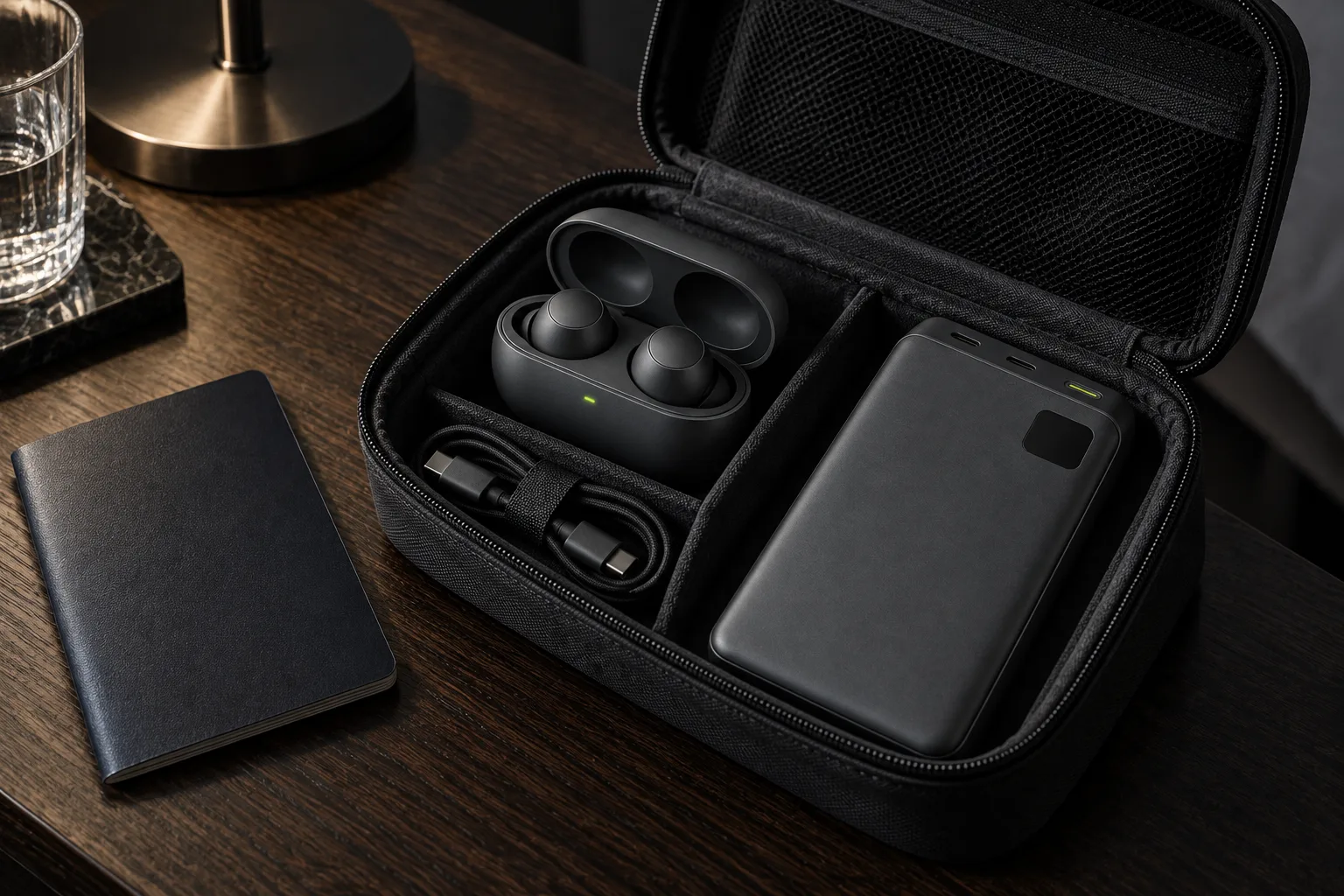
Three days, one pouch, one charger. This is the packing list our team actually uses for a business trip, and the shorter version for a weekend out of town when the laptop stays at home.
The rule behind both lists is simple: every device in the bag should charge from the same port and the same cable. Once that is true, one charger and one power bank cover everything, and the pouch gets smaller with every trip. We weighed each list on a kitchen scale and ran it through two real trips, Portland to Chicago for three days and a weekend on the coast.
The three-day business trip
A laptop changes the list, because it needs real power. Everything else is built around one charger that can feed it.
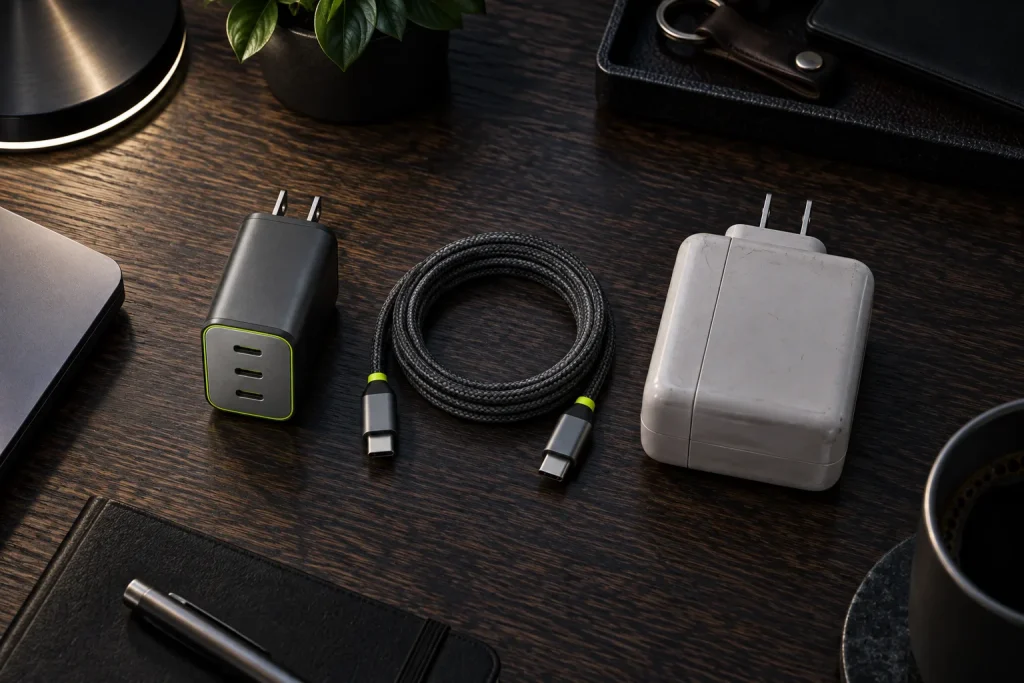
- One 65 W charger. Brick 65 charges a 13–15″ laptop and a phone at once, at 45 + 20 W, and accepts 100–240 V, so abroad it needs only a plug adapter.
- Two USB-C cables. One rated for 100 W for the laptop, one shorter for the phone. Link USB-C in 6 ft reaches from a hotel outlet to the bed.
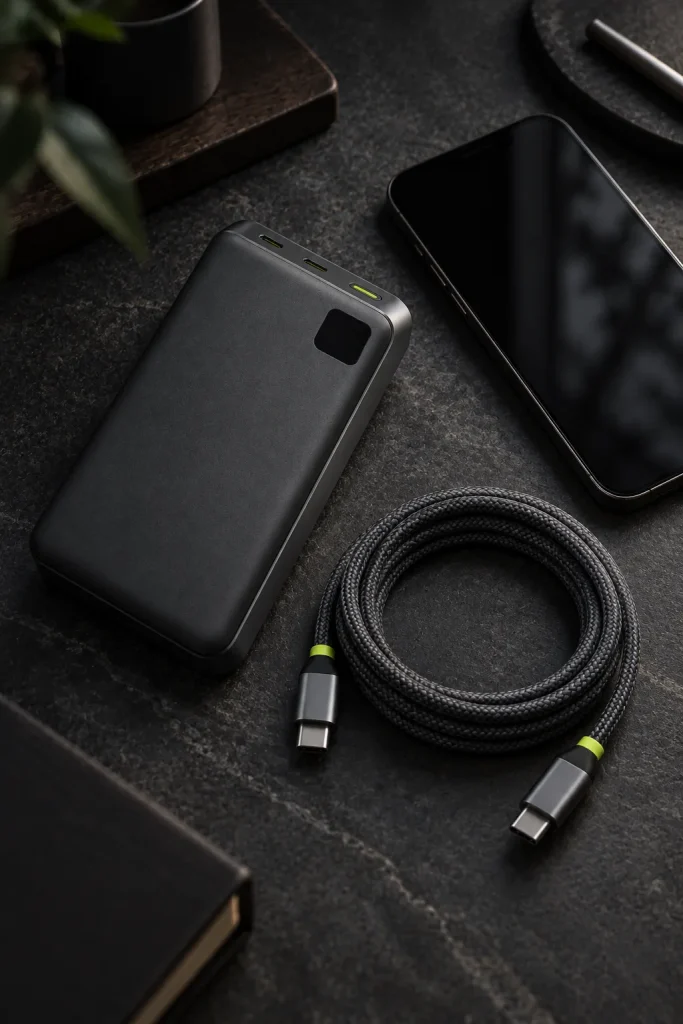
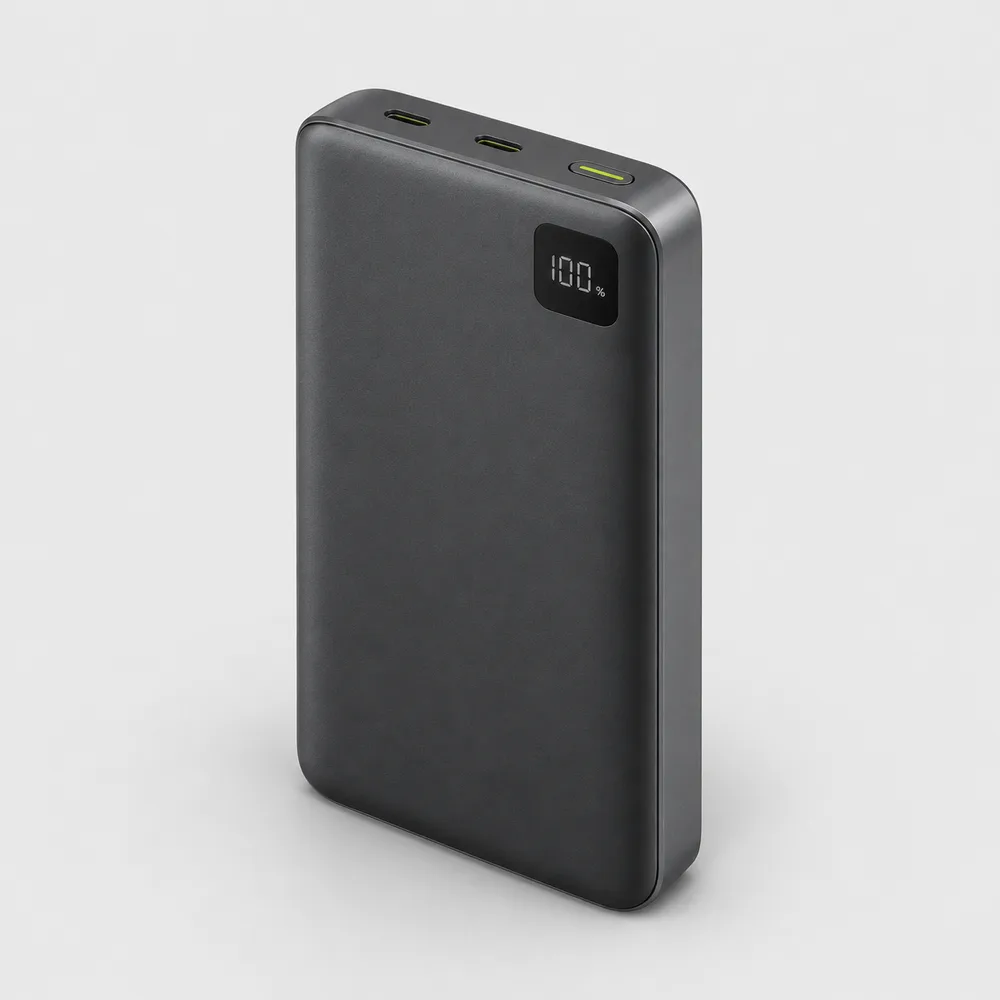
- One power bank. Cell 20 charges a laptop at 45 W, which matters on a delayed flight more than anywhere else.
- Noise-cancelling headphones. On a four-hour flight, Arc ANC used about a tenth of its battery; our ANC guide explains what it filters out and what it does not.
On the Chicago trip, Cell 20 took a 13″ laptop from 15 to 80 percent during a three-hour delay at the gate, then still had enough left for two phone charges the next day. In the hotel, Brick 65 charged the laptop, the phone and the power bank overnight from one outlet behind the nightstand. Before you pack a power bank, check what the airline rules say: it goes in your carry-on, never in the checked bag.
How you pack the pouch matters too. Coil cables loosely in loops the size of your palm instead of wrapping them tight around the charger, which strains the ends where they fail first. Keep the charger and its cables in one pocket and the power bank on its own, where you can reach it at security: some airports ask you to take it out of the bag with the laptop.
The weekend version
Without a laptop, the list shrinks to things that fit in a jacket pocket. We swap the headphones for Pod Mini earbuds, whose case holds 30 hours of listening, and keep Cell 20 for the phone and the camera. On the coast, the phone was our map, camera and ticket for two days; it needed one top-up from the power bank each afternoon. The earbuds never left the case for long enough to need the charger: two 45-minute walks a day used less than half of one charge, and the case is rated IPX5 for sweat and rain. Brick 65 stays in the bag anyway, because at 4.2 oz it weighs less than the spare cables people pack instead.
| Item | Business trip | Weekend | Weight |
|---|---|---|---|
| Brick 65 charger | Yes | Yes | 4.2 oz |
| Cell 20 power bank | Yes | Yes | 12.7 oz |
| Link USB-C, 6 ft | Yes | Yes | – |
| Short USB-C cable | Yes | No | – |
| Arc ANC headphones | Yes | No | 9 oz |
| Pod Mini earbuds and case | No | Yes | 2 oz |
“I used to travel with four chargers and still ran out of outlets. Now it is one charger, one power bank and two cables, and the pouch fits next to my passport.”
Emily Carter, Voltline customer in Seattle
What we leave behind
Packing light is mostly a list of things you stop carrying. These are the ones we dropped after a few trips and never missed:
- The laptop’s own adapter. If the laptop charges over USB-C, a 65 W GaN charger replaces it at a third of the size.
- A separate phone charger. The second port on the laptop charger does the same job.
- Single-device cables. Old micro-USB and proprietary leads stay in the drawer; anything that cannot charge from USB-C stays home with them.
- A tablet as well as a laptop. On a three-day trip one screen is enough; the second one mostly adds another thing to charge.
- A travel speaker. Hotel walls are thin, and the phone speaker is enough for a podcast in the shower.
The cables deserve a second look before you go. A cable from a phone box may carry only 60 W, or much less, and charges a laptop slowly; our guide to which USB-C cable charges a laptop explains how to tell them apart.
-
Shop the story
Original price was: $69.$59Current price is: $59.Ships in 1 business day
View: Cell 20
Quick answers
How many times does Cell 20 charge a phone?
About four times for a typical phone, from 10 to 100 percent. Its 74 Wh is the capacity of the cells; some energy is lost to heat on the way, so the usable amount is closer to 50 Wh.
Can I charge the power bank and my phone from Brick 65 overnight?
Yes. With two devices plugged in, Brick 65 shares its power as 45 + 20 W. Put the power bank on the top port: it recharges at up to 45 W and is full in about two hours, well before morning.
Do I need a voltage converter abroad?
Not for Brick 65. It runs on 100–240 V, so a simple plug adapter for the country is all you need, and Cell 20 recharges from it over USB-C like everything else in the pouch. Hair dryers and some older adapters are a different story, which is one more reason to leave them at home.

One response
Author
I finally left the second charger at home. One 65 W brick and one long cable covered a week in Lisbon for two of us.
Comments are closed.